
Premade Pizza Bases vs Making Dough In-House: What’s the Real Cost?
Every hospitality operator has had the conversation at some point. Should we be making our dough in-house? Wouldn’t that give us more control? Wouldn’t it be cheaper?
The honest answer is: sometimes, but less often than people assume. And the true cost of in-house dough production goes well beyond the price of flour.
Here’s a practical breakdown of what you’re actually comparing.
The Real Cost of Making Dough In-House
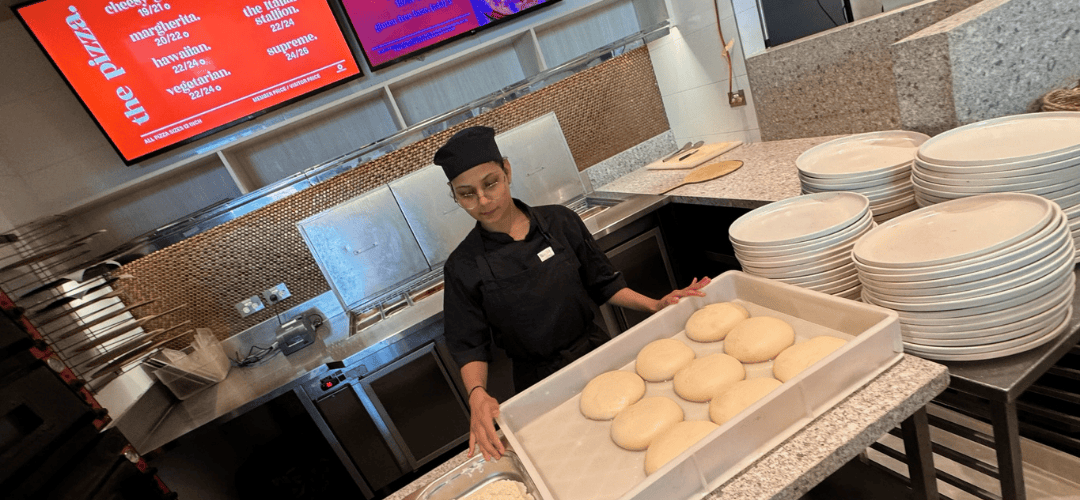
Labour is the biggest hidden cost. Making dough from scratch requires skilled time – often from your most experienced kitchen staff. Factor in the time to weigh ingredients, mix, develop the gluten, portion, ball, proof and store. Across a week of service, that adds up to significant paid hours dedicated to a task that could be eliminated entirely.
Skills are increasingly hard to find. Proper dough making requires knowledge and experience – knowing when the dough has developed correctly, how to adjust for humidity, how to proof consistently. Pizzaiolo skills are specialist skills and specialist skills command a premium wage. The skills shortage in Australian hospitality makes this more acute, not less.
Consistency is harder to maintain than it appears. Even with a good recipe and skilled staff, in-house dough introduces variables that are difficult to control – water temperature, ambient humidity, mixing time, proofing environment. When variables exist, inconsistency follows. When inconsistency follows, product quality suffers.
Wastage is an invisible cost that compounds. Dough that over-proofs gets thrown out. Dough made for a busy service that doesn’t eventuate gets thrown out. Batches that don’t develop correctly get thrown out. Every bin bag of wasted dough is margin walking out the door.
Kitchen space has a dollar value. The bench space, fridges and equipment dedicated to dough production are space and assets that can’t be used for anything else. In a commercial kitchen where every square metre has a cost, that’s a real consideration.
What Premade Bases Actually Cost You
The cost of a quality premade pizza base or dough ball is visible, fixed and predictable. You know the cost per unit before service starts. There’s no labour, no wastage variable, no skill dependency and no storage complexity beyond freezer space.
The trade-off people often cite is quality – the assumption that in-house dough will always produce a better result. This assumption doesn’t hold up when the premade product is made using proper fermentation methods and quality ingredients.
Buvetti products are made using traditional Italian methods – dough balls are proofed and hand stretched, not sheeted. The sourdough formulation is built for flavour. The result consistently surprises operators who assumed premade meant compromise.
Where In-House Production Still Makes Sense
To be balanced: there are operations where in-house dough production makes sense. Venues with a dedicated pizzaiolo, a pizza-focused menu and the volume to justify the labour investment can produce a product that’s genuinely differentiated. Artisan pizza restaurants where the dough-making process is part of the customer experience and brand story have good reason to keep it in-house.
But for the majority of commercial kitchens – pubs, clubs, restaurants running large menus, school canteens, catering operations – the operational and financial case for a quality premade product is strong.
The Question Worth Asking
The right question isn’t “premade or in-house?” – it’s “where do I want my kitchen team’s time and skill to go?”
If the answer is on service, on consistency, on reducing variables and on running a more profitable operation, premade is worth a serious look.
If you want to run the numbers for your specific operation, the Buvetti team is happy to work through it with you. Get in touch at buvetti.com.au or call 02 9121 6260.